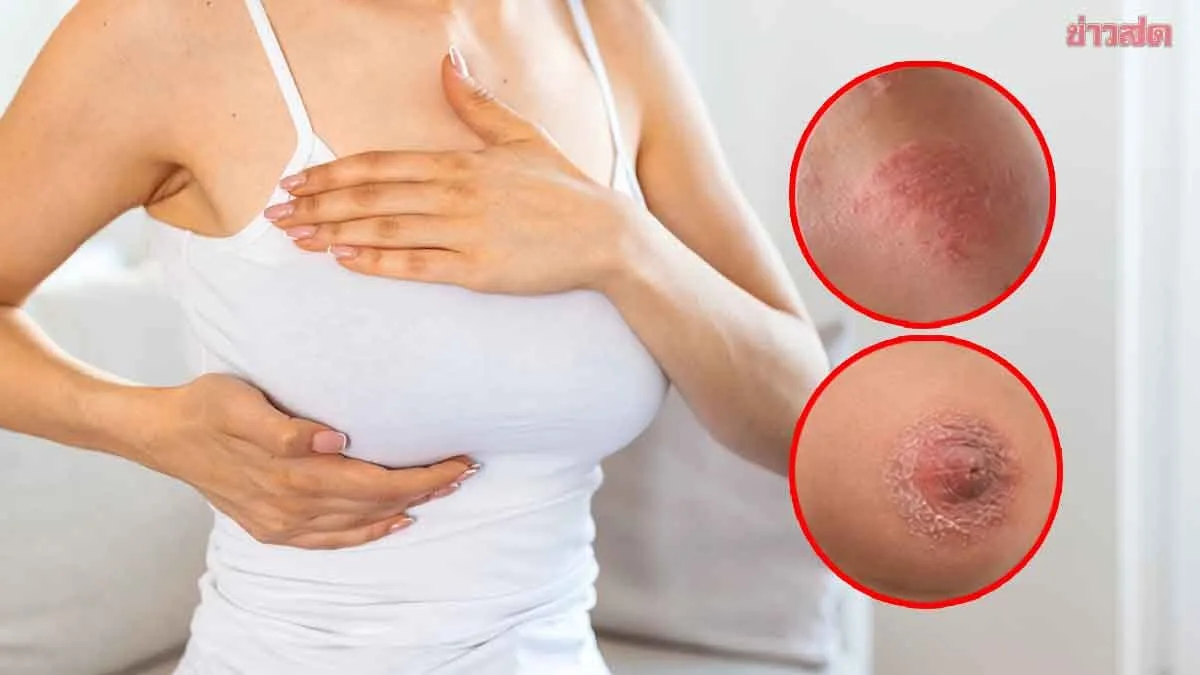
Not all breast cancer presents as a lump—inflammatory types may cause red, swollen skin or an orange-peel appearance instead, warns a Thai hospital doctor listing seven key warning signs to watch for.
Dr. Jetsada Bunyavongsirot, deputy director of primary care at Maha Rachachon Hospital in Nakhon Ratchasima, posted on Facebook explaining warning signs of breast cancer. He stressed that not feeling a lump does not mean you don't have breast cancer. Some types of breast cancer, especially inflammatory breast cancer, may begin with red, swollen, hot skin or an orange-peel-like appearance rather than a distinct lump. If one breast changes noticeably from before, don't wait—months of watching could delay critical diagnosis.
Seven key warning signs to watch for:
1. Dimpled, puckered, or wrinkled skin: If breast skin shows dimpling as if pulled from inside, especially visible when raising your arm, or if the breast shape becomes distorted, seek examination immediately. Deep abnormal tissue may pull on the fascia and skin even if you can't feel a distinct lump.
2. Thickened skin with prominent pores resembling orange peel (Peau d'orange): This occurs when lymphatic drainage beneath the skin becomes blocked, causing fluid to accumulate in the breast. This is a key sign of inflammatory breast cancer, which often has no palpable lump.
3. Red, swollen, hot, or rapidly enlarging breast on one side: While redness doesn't always indicate cancer—it could be infection or ordinary inflammation—widespread redness, heat, heaviness, swelling, or rapid size changes within weeks, especially in non-breastfeeding women, warrant immediate examination. Inflammatory breast cancer can mimic ordinary inflammation, and if it doesn't improve with infection treatment, it should not be ignored.
4. Newly inverted nipple: If a previously protruding nipple is drawn inward, tilts, changes shape, or shows skin tightening around it, see a doctor. Abnormal tissue may be pulling on milk ducts or tissue from inside.
5. Rash, redness, peeling, or non-healing sores on the nipple: Nipple rash may be simple allergic dermatitis or eczema, but if it starts on one nipple only, peels in flakes, itches, burns, has clear discharge, or doesn't heal with treatment, watch for Paget's disease of the nipple—a type of breast cancer affecting the nipple area. Don't apply cream repeatedly for months without knowing the cause.
6. Spontaneous fluid or blood discharge from the nipple: While milk during pregnancy or breastfeeding is normal, spontaneous discharge without squeezing—especially from a single duct on one side, clear like water, or blood-tinged—requires examination. Abnormalities may exist within milk ducts and be invisible from outside.
7. One breast changing in size, shape, or feeling abnormally heavy: Slight asymmetry is normal, but rapid enlargement, shape change, or noticeably increased weight, firmness, or tightness on one side should be investigated—don't blame it solely on weight gain or hormones, especially if accompanied by skin redness, thickening, nipple changes, or lumps under the armpit.
If you notice changes, document them by photographing in consistent lighting and angles to track any progression.