Thai Researchers Discover Five New Water Lily Species
Thai researchers have identified five new water lily species across the country, with detailed morphological and genetic analysis revealing tiny ornamental varieties previously unknown to science. The discovery, led by Kasetsart University
On July 6, Dr. Nathapol Nobphrajarenggul, an ecologist at the National Science Museum's (NSM) Natural History Institute, revealed that a Thai research team led by Assoc. Prof. Dr. Chaleumpol Suwan-aphakdi from Kasetsart University's Department of Botany, in collaboration with Prof. Dr. Trevor R. Hodkinson from Trinity College Dublin, Ireland, discovered five new water lily species (Nymphoides). This discovery reinforces Thailand's position as a critical global biodiversity repository, with countless organisms still awaiting scientific identification.
Dr. Nathapol explained that Thailand previously had records of approximately 5-6 Nymphoides species scattered across wetlands, marshes, rice fields, and swamps nationwide. However, the latest study integrated morphological characteristics with cytogenetics analysis, enabling more precise species classification and leading to the identification of five new species:
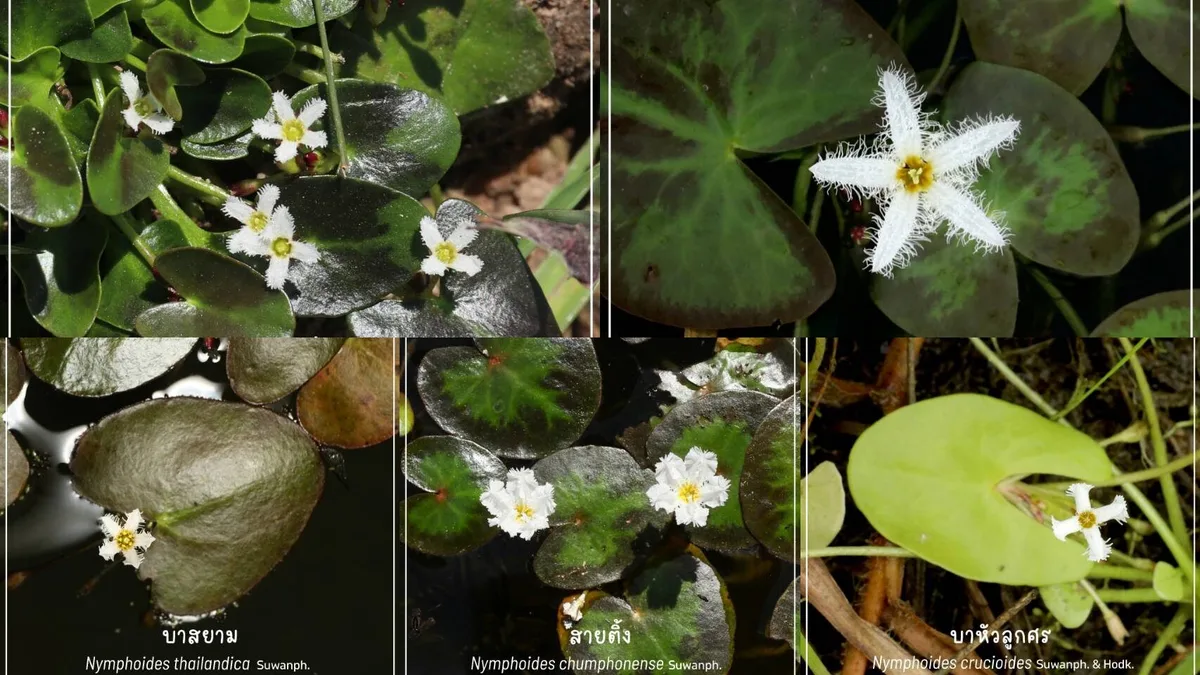
1. Sai Ting (Nymphoides chumphonense Suwanph.) - Found exclusively in Chumphon Province, featuring heart-shaped leaves with dark purple-tinged edges and white flowers 1.2-1.5 cm in diameter. It's a traditional vegetable consumed fresh with chili paste and sold in local markets, currently classified as near-threatened.
2. Bua Ba Hua Luuk Sok (Nymphoides crucioides Suwanph. & Hodk.) - Located in rice fields along ancient sand ridges in Prachuap Khiri Khan and Yala provinces. It has horseshoe-shaped leaves with white, cross-shaped four-petaled flowers (5-7 mm diameter) and thrives in both aquatic and terrestrial forms, showing potential as ornamental plants for terrariums, glass gardens, and aquatic displays. Currently near-threatened.
3. Ba Chiao (Nymphoides miniata Noppornch. & Suwanph.) - Thailand's smallest water lily species, possibly the world's tiniest, with heart-shaped leaves approximately 2.5 cm wide and deep purple-red tinges on green foliage. Its white flowers measure just 3-5 mm in diameter. Found in Prachuap Khiri Khan's ancient sand ridge rice fields, it grows in both aquatic and terrestrial forms with high ornamental potential. Currently near-threatened.
4. Ba Siam (Nymphoides thailandica Suwanph.) - Discovered in rice fields along ancient sand ridges in Prachuap Khiri Khan and Yala. It features heart to triangular-shaped leaves (2-4 cm) with dark purple-red tinges and white flowers (6-9 mm diameter). Capable of growing in both aquatic and terrestrial forms with ornamental potential. Currently near-threatened.
5. Dao Roda (Nymphoides thungyaiensis Suwanph. & Noppornch.) - Found in Umphang District, Tak Province, with heart-shaped leaves tinged reddish-brown and white five-petaled flowers densely covered in fine hairs (1.2-1.5 cm diameter). Critically near-threatened, with only one known natural population.
The research was published in the international Q1 academic journal Aquatic Botany, Volume 207, in 2026.